Positive formal thought disorder presents as speech in which individual associations can remain understandable even as the wider topic becomes difficult to follow. The shallow cognitive map hypothesis explains this by proposing that the relational representations which organise thought become insufficiently separated or stable. This allows associations which are meaningful in isolation, but inappropriate to the current context, to influence the direction of thought. What produces this shallowing, however, remains unclear.
This thesis asks whether noradrenaline could provide the relevant mechanism. It will broadly proceed in three parts. The first will explain cognitive maps and the shallow cognitive map hypothesis. The second will examine how noradrenaline affects hippocampal inhibition, excitability and plasticity, before presenting two ways it might shallow cognitive maps: by broadening the associations encoded during learning or by making established representations less stable during thought. The third will assess the relevance of this model to schizophrenia and mania, consider competing explanations, and outline experiments that could distinguish between them.
Unfortunately for the account, the current evidence stops short of showing that this process causes PFTD. Noradrenergic manipulation has been shown to alter relational representation, but this alteration has not yet been directly connected to disorganised speech. The account should therefore be treated as a testable extension of the shallow cognitive map hypothesis, rather than an established explanation of PFTD.
Introduction
Positive formal thought disorder (PFTD) is characterised by speech in which the relationship between successive ideas becomes difficult to follow. Its features include derailment, tangentiality, loose associations and, in more severe cases, incoherence (Andreasen, 1979). These features are observed most commonly in schizophrenia and mania, although PFTD is not specific to either diagnosis (Stein et al., 2023). Because the same disturbance occurs across diagnoses, the explanation should focus on the cognitive failure underlying the symptom and not the diagnosis in which it occurs. An account of PFTD must explain why a person continues to produce meaningful words and local associations while failing to preserve an appropriate relationship between those associations and the wider topic.
Formal thought disorder includes positive and negative dimensions. Positive features involve unusual, excessive or poorly organised speech, whereas negative features involve reduced quantity or content. An account of PFTD requires a mechanism capable of preserving individual associations while disrupting their organisation according to the broader context. Relational representations provide one potential mechanism through which this contextual organisation could occur. Musa et al. (2022) develop this possibility through the shallow cognitive map hypothesis, proposing that hippocampal relational representations become insufficiently separated or stable, allowing associations outside the current context to exert excessive influence.
Speech is used to identify PFTD because thought cannot be observed directly. The term therefore refers to a disturbance inferred from the organisation of language. This creates a further requirement for the proposed mechanism. It must not only explain altered association between concepts, but also explain how this alteration is expressed in the organisation of speech. The observable outcome will depend on language production, working memory and the demands of the interaction. The cognitive map hypothesis concerns one input to these processes: the relational structure that determines which concepts and memories become available from the current context.
The shallow cognitive map hypothesis develops this account by proposing that PFTD is mediated by disorganised cognitive maps produced by shallow neural attractors in the hippocampus (Musa et al., 2022). Cognitive maps organise relationships between objects, events and states. When experiences share an element, that common element can connect relations learned on separate occasions: two routes that meet at the same junction, for example, can be recombined into a path that was never travelled end to end. This flexibility also creates a potential source of error. If activation spreads excessively across related representations, the resulting inference may link experiences in ways that are not supported by experience. If these representations guide the concepts made available during thought, excessive spread provides a possible mechanism for the loose and poorly constrained associations observed in PFTD.
The shallow cognitive map hypothesis identifies a pattern of disrupted relational representation, rather than attributing PFTD to dysfunction in a single neural circuit. It leaves open which molecular changes could produce this dysfunction. This thesis examines noradrenaline as one candidate mechanism. The argument moves from evidence that the hippocampal system represents abstract relational structure, through evidence that noradrenaline changes inhibition, plasticity and the spread of learned associations, to the proposal that excessive relational spread could weaken contextual constraint over thought.
This argument does not require the claim that noradrenaline is the sole cause of PFTD. Noradrenergic signalling is receptor-dependent, state-dependent and distributed across several brain systems. The clinical evidence linking it specifically to PFTD is also limited. The stronger claim supported here is that noradrenaline can produce a defined change in relational representation that is consistent with the shallow cognitive map hypothesis, and that this change generates testable predictions about PFTD. The distinction is necessary because evidence that a mechanism can produce a predicted effect is not evidence that it does so in patients. The purpose of the thesis is therefore to develop the mechanistic account, assess how far the available evidence supports it and identify what would be required to establish a causal role.
The available evidence is asymmetric. Koolschijn et al. (2026) directly link a noradrenergic manipulation during learning to hippocampal and parahippocampal representational spread and to later relational errors in healthy adults. No study has connected the same manipulation and representational change to PFTD. Receptor and plasticity findings support a role for noradrenergic signalling in hippocampal plasticity and relational representation, while clinical findings of conceptual disorganisation do not identify noradrenaline as the cause. These differences in the evidence shape how strongly the proposed link can be supported.
A complete causal account would require experiments linked by shared operational measures. Noradrenergic manipulation should alter a neural measure of proximity-graded relational spreading, and the magnitude of that change should predict later proximity-graded errors. The same relational task and neural analysis should then be used in participants assessed for PFTD, alongside a speech measure that separates local semantic association from global topic constraint. Current evidence supports the connection between noradrenergic manipulation, neural spreading and relational errors; the proposed connection to disorganised speech remains theoretical.
Accordingly, the intended contribution is limited. This account specifies a candidate source of the poorly constrained relational representations that language and executive processes must organise and control. It does not replace explanations based on language, executive control, or other neuromodulatory systems, including dopamine. Noradrenaline is therefore judged by whether it can explain the spread and stability of associations and generate discriminating predictions.
Chapter 1: Cognitive Maps and Positive Formal Thought Disorder
Cognitive maps as relational representations
Edward Tolman introduced the cognitive map to explain flexible navigation that a chain of learned stimulus-response movements could not readily capture (Tolman, 1948). Rats could acquire information about a maze without immediate reward and later use that knowledge when a goal became relevant. A cognitive map allows an animal to recompute a route when a familiar path is blocked because the map represents where paths and goals lie relative to one another. O’Keefe and Dostrovsky (1971) supplied a neural basis for this proposal by showing that individual hippocampal neurons, later termed place cells, fired selectively when an animal occupied particular locations. Their finding suggested that the activity of a hippocampal population could represent location within a wider spatial structure. Subsequent work established the hippocampal formation as a central system for representing spatial relationships (O’Keefe & Nadel, 1978).
Thought disorder concerns relationships between concepts and ideas, so spatial navigation can supply the organising principle but not the required evidence. Garvert et al. (2017) exposed participants to object sequences generated by transitions on a non-spatial graph without revealing its structure. During subsequent fMRI, the hippocampal-entorhinal system varied with the relational separation between objects in that graph. The result suggests that this system can represent discrete, non-spatial relationships using a map-like metric even when participants lack explicit knowledge of the structure.
This extension changes what is meant by a location in a cognitive map. In a formal graph, each represented object, event or state can be described as a node, but the term does not imply a physical position. Links between these elements encode relationships learned from experience, and the map is abstract because its organisation is defined by relational rather than physical position. This does not show that individual words or concepts are stored as hippocampal equivalents of place cells. It supports the narrower claim that the hippocampal system can represent the relational structure within which objects and events are embedded. That structure can influence which states are treated as close, which transitions are expected and which novel relationships are inferred.
One way to describe this organisation is through a predictive representation. A state can be represented partly in terms of the states that are likely to follow it. States with similar expected successors will consequently have similar representations even if they were not directly paired. Garvert et al. (2017) found that a measure based on weighted future states accounted for the map-like structure observed in hippocampal-entorhinal activity. This is relevant because it gives relational distance a computational meaning. Two items are close when they participate in similar transition structures, not when they share a verbal label or perceptual feature.
Extending this principle to concepts introduces an additional problem in that relationships between concepts change with context. "Bank" participates in one structure when the topic is money and another when the topic is a river. A conceptual map must therefore represent not only association, but which relational structure is currently relevant. PFTD may not require the underlying semantic relationships to be false. It may arise because the current context fails to determine which valid relationships govern subsequent activation. A shallow or overlapping representation would then increase the influence of a relationship that is meaningful elsewhere but inappropriate to the present topic.
The spread of activation must therefore remain constrained by context. If activation spreads only between states with a strong learned relationship, the resulting inference is likely to preserve relevant structure. If it spreads across states with weak or indirect relationships, the map can support an association that extends further than the evidence provided by experience. The distinction between inference and overgeneralisation is therefore not the presence or absence of association. It concerns the distance and strength over which an association is allowed to influence behaviour. A map with no spread would preserve direct experience but support little flexible inference. A map with excessive spread would support novel relationships at the cost of representational precision.
Attractor states and representational stability
The shallow cognitive map hypothesis explains this constraint using neural attractors. An attractor is a stable pattern of activity towards which the state of a dynamical system tends to converge. In a neural network, recurrent connections within the currently active population amplify and maintain its pattern after the initiating input has ended. The same activity recruits inhibitory interneurons, which limit further firing within the active population and suppress neurons belonging to competing patterns of activity. A competitor that receives too little net input cannot establish the recurrent activity needed to sustain itself. These feedback processes create a range of possible activity patterns in which small perturbations are drawn back towards the current pattern of activity.
Attractor depth describes the stability of a state relative to possible alternatives. A deep attractor is one in which the current pattern of activity tends to persist despite perturbation. A shallower attractor is more susceptible to perturbation and more likely to be displaced by a competing state (Figure 1). Relative depth is important because multiple representations are available at the same time and compete for expression. The stability of the current state therefore depends on its activity relative to neighbouring states, not only on its absolute level of excitation.
Attractor shallowing must be distinguished from two related changes. The first is reduced separation between representations. If two cell assemblies overlap more strongly, activation of one will also activate more of the other. This increases interference between neighbouring states even if each state remains internally stable. The second is increased noise, which introduces transient perturbations that can push activity away from the current attractor. All three changes can increase inappropriate transitions, but they make different predictions. Reduced separation should produce structured errors concentrated among related states. Increased noise should produce less structured variability. Shallower attractors should reduce the persistence of the current state and increase its sensitivity to competing input.
These distinctions are important when interpreting evidence for the shallow cognitive map hypothesis. A behavioural tendency to confuse neighbouring items provides evidence that the representations are less distinct, but it does not by itself show that an attractor basin has become shallower. Similarly, a wider neural response around one represented item may reflect greater overlap produced during learning rather than reduced stability during retrieval. The broader term shallow cognitive map can describe these changes at a functional level, but a mechanistic account must specify which network property has changed.
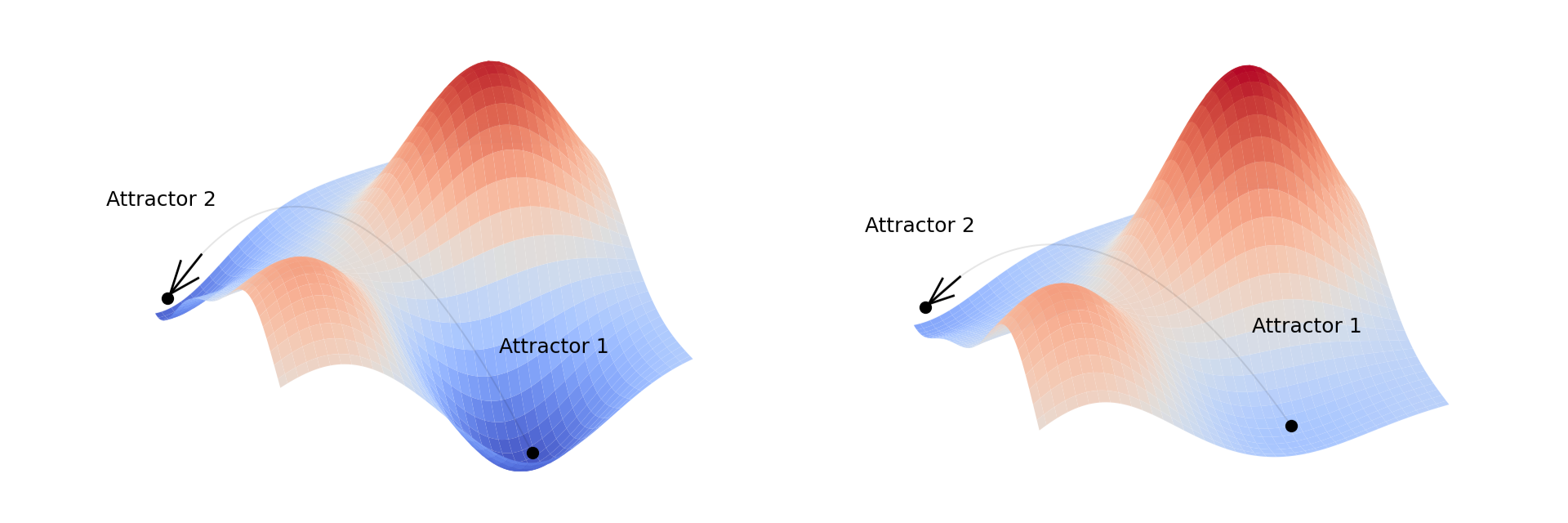
Deeper attractor landscape Shallower attractor landscape
Figure 1. Attractor landscapes under relatively deep and shallow conditions, adapted from Musa et al. (2022).
From relational instability to PFTD
PFTD can be described as a failure to maintain an appropriate relationship between the meaning of individual transitions and the overall coherence of the discourse. A person may produce a sequence in which each transition has an identifiable association while the sequence as a whole moves away from the question or topic. When asked about the energy crisis, one schizophrenic patient responded: "They're destroying too many cattle and oil just to make soap. If we need soap when you can jump into a pool of water, and then when you go to buy your gasoline, my folks always thought they should get pop, but the best thing to get is motor oil, and money" (Andreasen, 1979, pp. 1319–1320). This illustrates how adjacent transitions can remain understandable, but the organising context is not maintained. Thus, associations are still present, but the current context no longer adequately restricts which of them are relevant to the response.
A cognitive map account explains this pattern in three stages. First, the current topic activates a relational state that includes contextually relevant concepts and experiences. Second, activation spreads to related representations, allowing information to be retrieved and a response to be developed. Third, the current context suppresses or fails to select alternatives that are only weakly related to the topic. PFTD is proposed to arise when the third stage is weakened. More distant states become competitive, and the system can move towards an association that is locally available but globally inappropriate.
This account does not imply that every transition in PFTD should be semantically distant. Reduced constraint can also produce excessive movement between strongly associated concepts. A speaker may remain within a chain of local associations while repeatedly failing to return to the higher-order topic. This distinction matters because semantic similarity between adjacent words is not equivalent to discourse coherence. PFTD concerns the organisation of transitions across time and at multiple levels. The predicted abnormality is therefore not simply lower similarity between successive words, but a reduced influence of the current relational context on the trajectory through conceptual space.
Evidence from verbal fluency is consistent with the general proposal that conceptual search is altered in schizophrenia, although it does not directly establish PFTD. Nour et al. (2023) used word embeddings and a computational model of word selection to quantify the influence of semantic similarity on verbal responses. Semantic similarity influenced word selection across participants but this influence was reduced in the schizophrenia group. The result supports the view that conceptual search can be described as movement through a structured semantic space and that this structure influences behaviour differently in schizophrenia. However, the reported effect related more clearly to negative symptoms than to PFTD. It therefore provides evidence for altered conceptual organisation in schizophrenia, not direct evidence for the proposed mechanism underlying PFTD.
A direct test must move beyond diagnosis level differences and examine variation in PFTD itself. The relevant abnormality should therefore be stronger in individuals with more severe PFTD, regardless of whether the individual has schizophrenia or mania. It should not be present to the same degree in every person with schizophrenia and it should not be inferred from diagnosis alone. This gives the hypothesis a clear empirical requirement: measures of relational spreading or reduced contextual constraint must correlate with PFTD after accounting for general memory ability, overall psychosis severity and medication effects.
Predictions of the shallow cognitive map hypothesis
Musa et al. (2022) predict that PFTD should be associated with impaired relational memory and hippocampal representations that increasingly confuse adjacent items across learned sequences. They further predict that different molecular and circuit abnormalities should contribute to PFTD in proportion to their ability to shallow hippocampal cognitive maps. These predictions make it possible to evaluate candidate mechanisms without assuming that the same biological alteration is present in every affected person. A molecular change is relevant if it produces the defined computational consequence and if that consequence relates to the symptom.
The noradrenergic extension adds more specific predictions. Increasing noradrenergic signalling during learning should produce relationally structured errors rather than a uniform decrease in accuracy. Confusions should be concentrated among items that occupy neighbouring positions in a learned map. The magnitude of neural representational spreading should predict later overgeneralisation. At the symptom level, the same tendency should predict weaker contextual constraint over conceptual transitions and should relate to PFTD severity more strongly than to overall clinical severity.
The extension also makes a distinction between formation and use of a cognitive map. If noradrenaline acts primarily by changing plasticity during learning, increased signalling should alter the enduring organisation of the map. The resulting errors should remain after the acute physiological effect has ended. If noradrenaline acts primarily by destabilising attractors online, the errors should depend more directly on noradrenergic state during retrieval or thought. These mechanisms are compatible but not identical. The available evidence is currently stronger for altered formation than for online destabilisation. The following chapters develop this distinction and consider whether both effects can be explained within the same account.
Chapter 2: Noradrenergic Modulation of Hippocampal Function
Organisation of the noradrenergic system
Noradrenaline is a neuromodulator released in the forebrain primarily by neurons in the locus coeruleus. Locus coeruleus projections reach the hippocampus and widespread cortical and subcortical regions (Schwarz et al., 2015). This anatomy makes noradrenaline suited to changing the gain, excitability and plasticity with which local circuits process their own inputs, rather than conveying the content of a particular memory or concept. Locus coeruleus responses are engaged by unexpected events and changes in task contingencies that require adaptation of task-related processing (Bouret & Sara, 2004). For the present argument, the important consequence is that the same relational experience may be encoded differently depending on the noradrenergic state in which it is learned.
Locus coeruleus activity includes brief event-linked responses and longer changes sustained across behavioural states (Aston-Jones et al., 1994). These patterns are relevant here because they imply different windows of action. A transient response can modify processing around a surprising trial, whereas a sustained change across a learning block can alter the network regime in which many associations are encoded. Koolschijn et al. (2026) elevated noradrenergic signalling pharmacologically across the learning period, so their result most clearly supports a sustained manipulation of encoding. It does not establish that tonic locus coeruleus activity is persistently elevated in PFTD, that claim requires separate evidence.
Noradrenergic effects are slower and more state-dependent than fast glutamatergic or GABAergic transmission. Noradrenaline primarily acts through G-protein-coupled adrenergic receptors (Bear et al., 2001). Receptor activation initiates intracellular signalling cascades that alter ion channels, calcium entry, transmitter release and plasticity. For example, activation of β-adrenergic receptors can engage the Gs-adenylyl cyclase-cAMP-PKA pathway (Gelinas & Nguyen, 2005). PKA then phosphorylates downstream targets that regulate membrane excitability and synaptic transmission. The result is modulation of the response to other synaptic input rather than a fixed excitatory postsynaptic potential.
All three major adrenergic receptor families, ⍺1, ⍺2 and β, are present in the hippocampus (Pazos et al., 1988; Reznikoff et al., 1986; Zilles et al., 1991). Their presence establishes that hippocampal computation is sensitive to noradrenergic state, but it does not establish a single direction of effect. ⍺1 and β receptor activation can increase aspects of neuronal excitability or plasticity, while ⍺2 receptors commonly reduce transmitter release or excitability through inhibitory signalling. The outcome depends on receptor location, cell type, concentration, timing and the state of the network when release occurs.
This receptor heterogeneity places a limit on any account that treats noradrenaline as a uniform increase in excitation. A network-level model can still use a simplified noradrenergic parameter, but the parameter must refer to a defined regime in which the net effect is known or assumed. In the present model, the relevant regime is increased noradrenergic signalling during learning that reduces inhibitory constraint and increases the range over which activity drives plasticity. A second, more tentative regime concerns increased excitability during online processing. These regimes should not be treated as interchangeable.
The relationship between noradrenergic signalling and cognitive operation is unlikely to be linear. The effect of a given change in noradrenergic signalling will depend on the state of the system, the receptors recruited and the capacity of inhibitory mechanisms to constrain plasticity. Under conditions in which these factors preserve selectivity, increased noradrenergic signalling may facilitate updating of relationships supported by experience. When those constraints are weaker, the same change may permit plasticity across a broader range of inputs, including relationships that are only weakly supported by experience. The model therefore predicts that noradrenaline regulates the width and selectivity of plasticity in a state-dependent manner, rather than exerting a uniformly beneficial or detrimental effect.
This non-linearity also affects clinical interpretation. Two people with the same measured increase in arousal may occupy different parts of the response function because of differences in receptor sensitivity and baseline state. A genetic or circuit change may therefore influence PFTD by altering sensitivity to noradrenaline rather than changing noradrenaline itself. The resulting change in network function is therefore a more defensible target than the claim that every affected individual has uniformly elevated noradrenaline release.
Relevant evidence comes from Bacon et al. (2020), who stimulated locus coeruleus terminals in mouse CA1 and found that noradrenaline made pyramidal neurons more likely to fire in response to incoming synaptic signals. This effect was mediated by β-adrenoceptors. Importantly, noradrenaline did not appear to increase the measured excitatory input to these neurons or reduce inhibitory input. Instead, it changed how readily the neurons converted existing input into spikes. This provides a mechanism by which noradrenaline can increase hippocampal output without producing a uniform increase in activity across the circuit.
Noradrenaline, inhibition and plasticity
The relevance of noradrenaline to cognitive maps is not limited to excitability. A cognitive map is formed through activity-dependent changes in the relationships between representations. When two states are co-active, plasticity can strengthen the connections that allow one to influence the other (Hebb, 1949). Inhibition restricts this process by limiting the range of co-activity (Wigström & Gustafsson, 1983). It therefore protects representational specificity as well as controlling overall firing.
Elevated noradrenaline can lower the threshold for synaptic plasticity and reduce inhibitory tone under some conditions (Hopkins & Johnston, 1984; Gelinas & Nguyen, 2005). This combination expands the set of synapses eligible for modification. Activity generated by the representation of one item can then influence related representations that would otherwise remain below the threshold required for plasticity. If the effect is graded, the strongest change should occur between directly linked or closely related representations and weaken as relational distance increases. The predicted result is a systematic widening of the relationship represented around each item, as opposed to random distortion of the map.
This effect can be described as an increase in the smoothing applied to a cognitive map. A narrow smoothing function preserves sharp differences between related representations. A wider function causes the representation of one item to include more information from items close to it within the learned structure. Some smoothing supports generalisation because related experiences are treated as sharing structure. If the function becomes too wide, relationships that were only indirectly experienced are represented too strongly and precision is lost. This provides a computational link between a molecular change in plasticity and a behavioural tendency to overgeneralise.
Experimental evidence for a spread of association
Koolschijn et al. (2026) provide the most direct evidence for this proposed role. They used a randomised, double-blind, placebo-controlled design in which participants received atomoxetine or placebo before learning a structured relational task. Atomoxetine blocks noradrenaline reuptake and was used to elevate noradrenergic signalling during learning. After a 90-minute delay, participants learned pairwise associations between bird stimuli. Each bird appeared with two neighbours, allowing the complete set to be arranged as a ring. Each pair was also presented in a particular contextual scene. Participants learned the pairwise bird associations through these contextual scenes but were not informed about the ring structure.
The task separated memory accuracy from the organisation of errors. Both groups learned the directly presented bird pairs to a high level and did not significantly differ in learning accuracy. Errors in the later implicit memory test were then classified by the position of the selected context relative to the bird on the ring. Choosing a context attached to a nearby position preserved relational proximity while extending the association beyond direct experience. A bias towards these nearby contexts therefore measured a structured spread of association rather than general errors of memory.
Participants returned four days later, after the acute effect of atomoxetine had ended. The atomoxetine group showed more overgeneralisation, with errors biased towards contexts associated with nearby positions on the ring. In this way, atomoxetine broadened generalisation beyond the directly learned associations without reducing memory accuracy for those associations. Persistence after washout therefore points to a change established during learning rather than an effect on retrieval performance.
Immediately after learning, cross-stimulus suppression in the atomoxetine group varied with the distance between birds within the learned ring structure in the right hippocampus and parahippocampal cortex while no significant spread was observed under placebo. The overall atomoxetine-placebo comparison across the combined hippocampal-parahippocampal region of interest was not significant, although a post hoc comparison in the right hippocampus was significant (Koolschijn et al., 2026). Within the atomoxetine group, the participant-specific strength of the hippocampal and parahippocampal proximity gradient predicted both measures of overgeneralisation four days later. The neural measure therefore identified the relational organisation expressed in later errors, rather than a general decline in accuracy.
Koolschijn et al. also measured cortical metabolites and pupil responses to characterise individual drug response. Atomoxetine reduced GABA+ in the lateral occipital complex and increased the Glx:GABA+ ratio. Because Glx indexes glutamate- and glutamine-related metabolites whereas GABA+ indexes GABA-related inhibitory metabolites, an increased Glx:GABA+ ratio indicates a relative shift toward excitation over inhibition. Within the atomoxetine group, lower GABA+ predicted stronger hippocampal-parahippocampal spread. During a subsequent oddball task, the atomoxetine group showed a larger sustained pupil dilation response to surprising stimuli from approximately six to ten seconds after stimulus onset. Because pupil dilation covaries with arousal-related neuromodulatory activity, including noradrenergic responses to surprising events, this larger response is consistent with enhanced noradrenergic reactivity under atomoxetine. Within that group, pupil response showed a positive trend with neural spread across the combined region of interest and a significant post hoc association in the right hippocampus while no corresponding relationship was observed under placebo. Their spiking network model then showed that learning under reduced inhibition was sufficient to produce graded co-activity and plasticity across neighbouring cell assemblies.
Taken together, these findings link an experimental manipulation to a specific representational and behavioural pattern. Atomoxetine increased proximity-biased errors, and the degree to which right hippocampal and parahippocampal cross-stimulus suppression varied with ring position immediately after learning predicted the later error bias. Persistence after washout further supports an encoding or plasticity mechanism. It is therefore reasonable to conclude that elevated noradrenergic signalling during learning can increase the spread of association within a cognitive map.
The study does not demonstrate every component of the shallow cognitive map hypothesis. Participants were healthy and the outcome was a memory error, not PFTD. The measured neural spread indicates reduced representational distinction or increased overlap, but it does not directly measure attractor depth. Atomoxetine also acts systemically, and the GABA+ measure was cortical rather than a direct measurement of hippocampal inhibition. The spiking network model shows that reduced inhibition is sufficient to generate the effect, not that it is the only mechanism involved.
Overgeneralisation should not be treated as equivalent to disorganisation. The errors remained ordered by position on the ring, so atomoxetine extended a learned relationship beyond direct experience without destroying the topology of the map. The experiment therefore establishes structured overgeneralisation. Connecting it to thought disorder requires additional evidence that relational spread weakens contextual control during ongoing thought, potentially in combination with impaired executive control.
The study is best understood as evidence for the first half of the proposed causal chain. It shows that elevated noradrenergic signalling can alter the organisation of relational knowledge in a direction predicted by the shallow cognitive map hypothesis. The remaining question is whether this form of spread can also destabilise the use of a map and whether either effect contributes to PFTD. Answering this requires a clearer separation between changes established during learning and changes in network dynamics during ongoing thought.
Chapter 3: A Noradrenergic Model of Cognitive Map Shallowing
Two routes to a shallow cognitive map
Noradrenaline could contribute to a shallow cognitive map through two related routes. The first is an encoding route. Elevated noradrenaline during learning reduces inhibitory constraint and broadens activity-dependent plasticity. Neighbouring representations consequently overlap more. When the map is later used, activation spreads across a wider relational distance because that spread has been embedded in the synaptic structure. This route is consistent with the results shown by Koolschijn et al. (2026).
The second is an online route. Noradrenaline may increase the excitability of multiple populations within an already formed attractor network. The current state is maintained by recurrent excitation, while competing states remain below the level required to sustain their own activity. If noradrenaline increases the responsiveness of competing populations, the difference between the active attractor and its alternatives can decrease. The current state then becomes more susceptible to competing input. This can be described as a reduction in relative attractor depth.
The two routes can produce similar behavioural outcomes while making different predictions. Encoding-related spread should persist after noradrenergic signalling returns to baseline. Online destabilisation should depend on noradrenergic state while the map is being used and should reduce when that state changes. An individual could also experience both. Repeated learning under elevated noradrenaline could create overlapping representations, while a later increase in noradrenergic state could make transitions between those representations more likely.
The routes also predict different error distributions. Encoding-related spread should remain tied to the relational structure learned during the period of elevated signalling. Errors should be concentrated among neighbouring states and should be reproducible when the same map is tested again. Online instability can operate across different maps and should vary with the current noradrenergic state. It may increase switching even where the stored relationships were formed under ordinary conditions. Increased noise would produce a third pattern in which transitions are less reliably related to distance. These distributions provide an empirical way to distinguish mechanisms that otherwise share the description of disorganisation.
These routes should not be collapsed into a single claim of increased excitation. The encoding route concerns which synapses change and the online route concerns which state controls activity at a given time. Keeping them separate prevents evidence for persistent overgeneralisation from being treated as direct evidence for transient attractor switching.
Encoding-related spread
During learning, representing one element of a relationship also evokes some activity in the representations linked to it. This distribution is not all-or-none. Directly linked elements tend to show more co-activity than elements connected only through several intervening relations. Inhibition restricts that co-activity and allows synaptic plasticity to preserve distinctions between representations. It can therefore be understood as limiting the width of the activity profile available for learning.
If noradrenaline reduces inhibitory tone, the activity profile becomes wider. Representations close to the current item within the learned relational structure receive enough activity to undergo stronger plasticity even where their relationship was not directly presented. Because co-activity weakens across successive learned links, the resulting change remains structured rather than diffuse. Closely related states become more similar while states separated by more links remain relatively distinct. This is the pattern consistent with the atomoxetine study and explains why elevated noradrenaline produced overgeneralisation without a general impairment in memory accuracy.
At the level of an attractor network, this change can reduce the separation between basins. Representations that previously occupied distinct regions of state space acquire greater functional overlap. Activation of one provides a larger initial input to the other, reducing the perturbation needed to move between them. The attractors need not become uniformly shallower. Their boundaries become less effective because neighbouring representations share more of the activity and connectivity that define them.
This mechanism provides a more precise interpretation of cognitive map shallowing. The relevant change is not necessarily a reduction in recurrent excitation within each representation. It is a reduction in relative distinctness created by graded plasticity across representations.
Online destabilisation
The online route begins with competition between an active attractor and alternatives. Neurons within the active representation support one another through recurrent excitation. This activity also recruits feedback inhibition, which prevents firing from increasing without limit and suppresses competing representations. The network can transition to an alternative attractor when activity corresponding to that state becomes sufficiently strong. Switching therefore depends on the difference between the current state and its alternatives.
Noradrenergic modulation can alter the activity difference between a current state and its competitors. In mouse CA1, optogenetically evoked endogenous noradrenaline increased the probability that pyramidal neurons fired in response to Schaffer collateral input (Bacon et al., 2020). β-adrenoceptor activation reduced the synaptic charge required to initiate an action potential, consistent with modulation of voltage-gated potassium channels, without changing the measured feedforward excitatory or inhibitory input. If a comparable increase in excitation-spike coupling occurs across populations in an attractor network, weak input to a competing population becomes more likely to initiate firing and recruit its recurrent connections.
In a recurrent network, the same modulation need not affect active and competing populations equally because they begin from different operating states. The active population is already sustained by recurrent excitation and has recruited feedback inhibition, so additional excitation can be partly opposed by inhibitory feedback and by the limited room for further firing. A competitor remains below the threshold for self-sustaining activity, so increasing excitation–spike coupling could make its neurons more likely to initiate firing and recruit recurrent excitation. Under this state-dependent assumption, a distributed noradrenergic input narrows the activity difference between the current pattern and a competitor more than it increases the current pattern's existing advantage (Khona & Fiete, 2022; Wang, 1999).
This online route remains a model assumption rather than an established noradrenergic effect on hippocampal attractor dynamics. Bacon et al. (2020) demonstrate increased single-cell output, not a comparison between active and competing assemblies, and hippocampal adrenergic receptors can affect pyramidal neurons and interneurons in different directions. Noradrenaline could therefore stabilise the currently relevant pattern under some network conditions. The claim is thus limited to a conditional one: if noradrenergic modulation raises subthreshold competitors more than it strengthens the active population, it will reduce relative attractor depth. No current evidence establishes that this condition is met during PFTD.
This assumption is testable. Neural population activity should be recorded during retrieval under controlled noradrenergic manipulation, and the current and competing representations identified from their distinct activity patterns. The model predicts that competing representations will show increased pre-transition activity and that the activity difference between the current and competing state will fall before switching. If noradrenaline instead increases the dominance or persistence of the active representation, the online component would be rejected even if the encoding component remained valid.
Relationship between spread and thought
To apply either route to PFTD, the represented states must influence conceptual selection. A current topic establishes a context that changes the relevance of possible memories and concepts. The word "oil" can participate in relationships involving energy, cooking, painting or engines. A well-constrained map contains these alternatives but keeps weak, context-inappropriate associations from displacing the relationship required by the current topic.
Encoding-related spread changes the structure supplied to this selection process. If neighbouring or indirectly related states have become more strongly linked, activation of the topic will make a wider set of material available. Online destabilisation changes the persistence of the selected state. Even where the map was learned normally, competing contexts can displace the current one more easily. Both routes reduce contextual constraint, but one does so by changing stored relationships and the other by changing the dynamics of selection.
The linguistic consequence is a sequence that remains locally associative but lacking coherence. When a context-inappropriate concept wins selection, it becomes the input for the next cycle of retrieval and selection. The set of immediately available relationships is therefore re-centred on that concept rather than on the original topic. Repeated re-centring can carry speech progressively farther from its starting point while preserving a recognisable association at each transition. This supplies the missing link between a single inappropriate transition and the sustained derailment that the shallow cognitive map hypothesis aims to explain.
The model does not imply that hippocampal dysfunction is sufficient for PFTD. Speech also depends on semantic representations in temporal cortex, selection and monitoring in frontal systems, working memory, and the integration of linguistic information with contextual and discourse-level cues (Barrera et al., 2003; Sharkey et al., 2024). Strong executive control may compensate for a wider spread of relational activation by maintaining the topic and suppressing irrelevant material. Conversely, impaired control may produce disorganisation even where hippocampal relational structure is normal. PFTD is therefore likely to arise from an interaction between the organisation of available associations and the systems that select among them.
This interaction produces a useful prediction. Relational spreading should be most closely related to PFTD when measures of contextual control are also weak. A patient with increased representational overlap but preserved control may show overgeneralisation on memory tasks without disorganised speech. A patient with impaired control but preserved relational organisation may produce reduced coherence for a different reason. The strongest PFTD should occur when both the representational input and its control are impaired.
Chapter 4: Relevance to Schizophrenia and Mania
Symptom-level rather than diagnosis-level evidence
The causal chain developed in this thesis takes PFTD as its clinical outcome. Musa et al. (2022) place the shallow cognitive map hypothesis within schizophrenia and discuss broader implications for the disorder, but the proposed chain itself is intended to explain conceptual disorganisation rather than the full syndrome. That distinction matters because schizophrenia is heterogeneous, many patients do not show severe PFTD, and PFTD also occurs during mania. A diagnostic group difference may instead reflect hallucinations, delusions, negative symptoms, medication, illness duration or general cognitive impairment. Tests of this model must therefore relate cognitive map organisation to PFTD severity within or across diagnoses.
This symptom-level requirement also prevents diagnostic-level associations from being mistaken for evidence of a symptom-specific mechanism. A hippocampal abnormality found in schizophrenia cannot be assigned to PFTD merely because PFTD occurs in schizophrenia. The same participants must be assessed for cognitive map organisation and for the predicted loss of contextual constraint in speech, or the proposed map mechanism must be manipulated directly. In such a joint design, noradrenergic state should predict neural relational spread, neural spread should predict relational overgeneralisation, and overgeneralisation should predict reduced global constraint over speech. Testing that sequence would add information beyond reproducing separate diagnosis-level correlations.
Current clinical evidence only partly meets this requirement. Large-scale structural work links positive FTD to a distributed network that includes temporal, frontal and parahippocampal regions (Sharkey et al., 2024). Computational studies also indicate that the organisation of conceptual search differs in schizophrenia (Nour et al., 2023). These findings make a relational account plausible, but neither directly measures noradrenergic signalling. Conversely, pharmacological evidence shows that noradrenaline can spread hippocampal relational representations in healthy participants, but it does not establish the presence of that change in PFTD. The two bodies of evidence currently meet at the level of a hypothesis.
A direct study would need to avoid treating a total Positive And Negative Syndrome Scale (PANSS) score as a sufficient clinical measure. PFTD should be assessed as a distinct dimension, with positive features separated from negative speech symptoms. Speech samples should also allow local association to be separated from global coherence. A single score for conceptual disorganisation may identify severity but will not show whether the predicted loss of contextual constraint is present. The behavioural task and language measure should therefore be selected to test the same computational property at different levels.
Medication and illness state must also be considered. Antipsychotic treatment can change symptom severity, arousal and monoaminergic signalling, while acute illness can affect attention and task engagement (Howes et al., 2012; Harris et al., 2006). These factors can generate apparent relationships between noradrenergic measures and performance. A strong design would record medication exposure, compare stable and acute states where possible, and include control measures for attention and general memory.
Noradrenergic evidence in schizophrenia and mania
There is some evidence that noradrenergic activity changes with clinical state in schizophrenia. Van Kammen (1990) measured cerebrospinal fluid noradrenaline and its metabolite MHPG in drug-free patients with chronic schizophrenia. Higher measures were associated with greater symptom severity, particularly among patients who relapsed following withdrawal of haloperidol. The authors interpreted increased noradrenergic activity as accompanying the intensification of symptoms without claiming that it caused them. This distinction remains appropriate. The study supports state-related involvement of noradrenaline but does not identify a hippocampal source, a receptor mechanism or a specific relationship with PFTD.
A similar state-related finding has been reported in mania. Swann et al. (1983) compared cerebrospinal fluid MHPG, HVA and 5-HIAA, metabolites of noradrenaline, dopamine and serotonin respectively, in 14 hospitalised manic patients and 62 healthy comparison subjects. MHPG was higher in the manic group and was the only measured metabolite that correlated with mania ratings. HVA and 5-HIAA did not differ between male patients and comparison subjects, although both were elevated in female patients. Kurita et al. (2014) later followed 24 patients with bipolar I disorder across mania and remission. Plasma MHPG fell as mania improved and was positively associated with symptom severity when manic and remission observations were compared, whereas HVA did not change significantly. These findings support an involvement of noradrenaline in mania, but the same interpretive limits apply. Both studies used indirect and spatially nonspecific measures, the samples were small, and in the longitudinal study clinical improvement occurred during treatment. They therefore do not establish a noradrenergic cause of mania or specific relationship with thought disorder.
Clinical noradrenergic findings also face substantial interpretive problems. Noradrenaline varies with arousal, stress, sleep, attention and medication (Carter et al., 2010). Each of these can differ during acute psychosis. A peripheral or cerebrospinal measure does not indicate the concentration acting on a particular hippocampal receptor population. Antipsychotic treatment can also affect several monoaminergic systems. Evidence of increased noradrenergic activity in acute illness therefore cannot be treated as evidence of the particular network regime proposed here.
The appropriate conclusion is that the clinical evidence supports state-related changes in noradrenergic activity in schizophrenia and mania, but does not establish that these changes are causal, hippocampally mediated, or specifically related to PFTD.
Genetic convergence and circuit susceptibility
Genetic evidence for schizophrenia converges on neuronal and synaptic dysfunction, but does not specifically implicate noradrenergic signalling. Trubetskoy et al. (2022) identified common variant associations at 287 loci and prioritised 120 genes. These signals were concentrated in genes expressed in excitatory and inhibitory neurons, while functional analyses implicated synaptic organisation and transmission. A complementary exome study implicated rare disruptive variants in ten genes, including the glutamate-receptor subunits GRIN2A and GRIA3 (Singh et al., 2022). The clearest convergence is therefore on neuronal and synaptic biology, not on noradrenaline itself.
These findings support a noradrenergic account only indirectly: they identify mechanisms that may alter a circuit’s response to neuromodulation, not which neuromodulatory system is disrupted. For example, risk-associated genes such as CACNA1C influence excitability or synaptic plasticity and could therefore alter responses to noradrenergic input. However, because the same mechanisms are recruited by glutamatergic, dopaminergic and other inputs, these associations cannot identify noradrenaline as the upstream disturbance.
Genetic overlap between schizophrenia and bipolar disorder is likewise compatible with shared circuit vulnerabilities, but does not establish a mechanism shared by PFTD across diagnoses (Cross-Disorder Group of the Psychiatric Genomics Consortium, 2013). Both disorders include many features unrelated to thought disorder, so diagnostic overlap alone cannot identify the mechanism of PFTD. A more informative design would compare people with and without PFTD within schizophrenia and within bipolar mania, and then compare the PFTD groups across diagnoses while matching them for PFTD severity. If proximity-graded representational spread tracks PFTD across these groups, the result would support a symptom-level mechanism. If it tracks PFTD in schizophrenia but not PFTD during mania, the present account would require revision.
The genetic evidence therefore supports a constrained circuit-susceptibility claim. Variation affecting inhibition, excitation or plasticity could change the amount of relational spreading produced by a given noradrenergic input, but this remains a hypothesis until genotypes predict the neural or behavioural response to noradrenergic manipulation. The most informative test would therefore ask whether risk variation moderates the effect of a noradrenergic manipulation on proximity-graded representational spread, rather than merely predicting diagnosis. Until then, genetics establishes the plausibility of altered circuit sensitivity to noradrenaline, not a noradrenergic cause of PFTD.
Chapter 5: Alternative Explanations, Limitations and Tests
Alternative explanations
The strongest competing neurotransmitter account is dopaminergic. Molecular imaging meta-analyses show elevated presynaptic dopamine function most consistently in the striatum in schizophrenia, and greater striatal dopamine synthesis capacity predicts response to dopamine-receptor-blocking antipsychotics in a substantial subgroup of first-episode psychosis (Howes et al., 2012; Jauhar et al., 2018). This clinical evidence is much stronger than the direct clinical evidence for noradrenaline. However, it concerns psychosis and treatment response broadly rather than PFTD specifically, and does not establish that dopamine accounts for the persistent, proximity-graded distortion predicted by the present noradrenergic encoding account.
The explanations are not mutually exclusive. Dopaminergic abnormalities could contribute to PFTD alongside noradrenergic dysfunction, while executive or semantic abnormalities could produce disorganised speech even when both neuromodulatory measures are normal. The relevant question is therefore whether altered noradrenergic signalling specifically affects learned relational structure and whether this effect predicts PFTD beyond dopaminergic, executive and semantic measures.
Atomoxetine does not by itself establish such specificity. Although it is selective for the noradrenaline transporter, systemic transporter blockade does not prove that every downstream effect is exclusively noradrenergic; in rat prefrontal cortex, atomoxetine increased extracellular dopamine as well as noradrenaline (Bymaster, 2002). The pupil, GABA+ and hippocampal findings in Koolschijn et al. make a noradrenergic interpretation plausible, but they are not receptor-specific. A discriminating experiment should compare adrenergic and dopaminergic manipulations while measuring the same learned-map gradient and speech outcome. If adrenergic blockade prevents the persistent proximity-graded encoding effect, the proposed mechanism would gain specificity. If dopaminergic manipulation reproduces the map distortion and accounts for PFTD more strongly, the noradrenergic claim should be narrowed.
Limits of the current model
The model is clearest when applied to experimental tasks, in which nodes and relationships are explicitly defined. Natural thought is less easily specified: a concept can participate in several structures at once, and the relevant structure changes with context. The model assumes that these structures can be represented as competing relational states, but it does not explain how a particular map is selected or how its nodes correspond to units measured in speech.
Noradrenergic effects also depend on dose, receptor location and baseline network state. More noradrenaline should not be assumed to produce proportionally more disorganisation. The atomoxetine findings identify one experimental regime in which increased signalling was associated with broader relational encoding but they do not define the full response function or establish where patients with PFTD lie on it.
Finally, the clinical evidence does not establish the complete proposed sequence. No study has yet shown that increased noradrenergic signalling, hippocampal representational spread and PFTD occur together in the same participants. The evidence supports individual links in the model, but not the full causal chain.
Measurement and causal interpretation
The proposed chain also depends on matching variables across levels without treating them as equivalent. Relational spread in an experimental task is not itself PFTD, and an unusual transition in speech is not a direct measurement of a cognitive map. Each step therefore requires a separate operational definition. At the behavioural level, map shallowing should appear as distance-dependent generalisation beyond the learned structure rather than a general reduction in memory. At the neural level, it should appear as increased similarity or reduced discrimination between relational states. At the level of language, it should appear as a reduced influence of global context on conceptual transitions after local semantic similarity has been considered. Keeping these measures separate prevents the theory from defining every unusual response as evidence of the same process.
An effective test would measure these levels in the same participants and examine the order proposed by the model. Noradrenergic state or manipulation should predict the neural measure of relational spread. The neural measure should predict the behavioural gradient of generalisation. These measures should then predict the degree to which speech moves away from its wider context. Mediation would not by itself prove the full causal chain, but it would be more informative than separate correlations between noradrenaline and symptoms, hippocampal activity and symptoms, or task performance and symptoms. The model is specifically supported when the intermediate measures account for the relationship in the predicted sequence.
Evidence that noradrenergic manipulation alters relational spread would support the molecular-to-network part of the model, but it would not establish that the same change causes PFTD. Evidence that PFTD is associated with relational spread would support the network-to-symptom part, but it would not identify noradrenaline as its cause. The complete account requires both results and a link between them. Failure at one stage should narrow the claim rather than being absorbed into a more general account of arousal or cognitive impairment. This gives the hypothesis clear points at which it can be revised or rejected.
Discriminating predictions
The proposed account can be tested as a causal sequence linking noradrenergic state, hippocampal relational precision and the organisation of speech. The first step is to establish whether the predicted reduction in relational precision is present in PFTD. The ring-structured paired-association paradigm used by Koolschijn et al. (2026) could be adapted for participants sampled across a dimensional range of PFTD severity. The model predicts that greater PFTD severity will be associated with a broader proximity gradient of indirect errors, despite separable measurement of accuracy for directly learned pairs. Using the corresponding fMRI cross-stimulus-suppression analysis, this behavioural gradient should be accompanied by reduced hippocampal differentiation between nearby positions in the learned relational structure.
If this relational imprecision contributes to thought disorder, it should also predict how constrained speech is by the topic. Speech from the same participants could be analysed using a model that estimates the distinct contributions of local semantic association and global topic structure to successive conceptual transitions. Greater behavioural and hippocampal spread should predict weaker constraint by the global topic. This relationship should survive adjustment for executive function, verbal ability and general symptom severity, thereby distinguishing the proposed mechanism from a nonspecific consequence of cognitive impairment.
A causal test would then manipulate noradrenergic signalling while measuring the same relational and linguistic outcomes. Manipulation during encoding should produce persistent changes in the proximity gradient if noradrenaline alters inhibitory constraint and the precision with which relational structure is learned. By contrast, effects restricted to retrieval -such as transient increases in switching or loss of contextual guidance- would implicate online regulation of an already established representation. Initial studies could use healthy participants varying in subclinical disorganisation or, where clinically appropriate, receptor blockade, avoiding the safety and interpretive problems of increasing noradrenergic activity in acutely unwell patients.
Finally, the account makes a transdiagnostic prediction. Across participants with schizophrenia and mania, relational spread should track PFTD severity rather than diagnosis alone. A diagnosis effect without a relationship to PFTD severity would suggest that the abnormality is a feature of schizophrenia rather than a mechanism of PFTD.
Conclusion
The shallow cognitive map hypothesis explains PFTD as a consequence of poorly constrained relational representations. Cognitive maps support flexible inference by allowing activity to extend beyond direct experience, but this process becomes maladaptive when association spreads further than the learned structure supports. Thought can then move through a sequence of locally meaningful associations while becoming progressively detached from the wider topic.
Current evidence establishes that noradrenaline can produce a representational change predicted by a theory of PFTD, while clinical and computational findings indicate that conceptual organisation is altered in relevant patient groups. No study has yet examined whether neural indices of hippocampal relational spreading are related both to noradrenergic state and to reduced contextual constraint in the speech of the same participants.
The proposed model sets out a possible sequence from noradrenergic modulation, through changes in relational representation, to disorganised speech. Each step can be tested without assuming that noradrenaline alone is sufficient to produce PFTD. Establishing whether this sequence operates in PFTD will require studies that relate neural and behavioural indices of relational spreading to PFTD severity, separate effects established during learning from those occurring during retrieval, and identification of the adrenergic receptors that contribute to each effect. Until then, noradrenaline should be considered a plausible mechanism for cognitive map shallowing rather than a demonstrated cause of thought disorder.
Bibliography
Andreasen, N. C. (1979). Thought, language, and communication disorders: I. Clinical assessment, definition of terms, and evaluation of their reliability. Archives of General Psychiatry, 36(12), 1315–1321. https://doi.org/10.1001/archpsyc.1979.01780120045006
Aston-Jones, G., Rajkowski, J., Kubiak, P., & Alexinsky, T. (1994). Locus coeruleus neurons in monkey are selectively activated by attended cues in a vigilance task. The Journal of Neuroscience, 14(7), 4467–4480. https://doi.org/10.1523/jneurosci.14-07-04467.1994
Bacon, T. J., Pickering, A. E., & Mellor, J. R. (2020). Noradrenaline release from locus coeruleus terminals in the hippocampus enhances excitation-spike coupling in CA1 pyramidal neurons via β-Adrenoceptors. Cerebral Cortex, 30(12), 6135–6151. https://doi.org/10.1093/cercor/bhaa159
Barrera, A., McKenna, P. J., & Berrios, G. E. (2004). Formal thought disorder in schizophrenia: An executive or a semantic deficit? Psychological Medicine, 35(1), 121–132. https://doi.org/10.1017/s003329170400279x
Bear, M.F., Connors, B.W. and Paradiso, M.A. (2001) Neuroscience : exploring the brain. 2nd ed. Baltimore, Md: Lippincott Williams & Wilkins.
Bouret, S., & Sara, S. J. (2004). Reward expectation, orientation of attention and locus coeruleus‐medial frontal cortex interplay during learning. European Journal of Neuroscience, 20(3), 791–802. https://doi.org/10.1111/j.1460-9568.2004.03526.x
Bymaster, F. (2002). Atomoxetine increases extracellular levels of norepinephrine and dopamine in prefrontal cortex of rat a potential mechanism for efficacy in attention deficit/hyperactivity disorder. Neuropsychopharmacology, 27(5), 699–711. https://doi.org/10.1016/s0893-133x(02)00346-9
Carter, M. E., Yizhar, O., Chikahisa, S., Nguyen, H., Adamantidis, A., Nishino, S., Deisseroth, K., & de Lecea, L. (2010). Tuning arousal with optogenetic modulation of locus coeruleus neurons. Nature Neuroscience, 13(12), 1526–1533. https://doi.org/10.1038/nn.2682
Cross-Disorder Group of the Psychiatric Genomics Consortium. (2013). Genetic relationship between five psychiatric disorders estimated from genome-wide SNPs. Nature Genetics, 45(9), 984–994. https://doi.org/10.1038/ng.2711
Garvert, M. M., Dolan, R. J., & Behrens, T. E. (2017). A map of abstract relational knowledge in the human hippocampal–entorhinal cortex. eLife, 6. https://doi.org/10.7554/elife.17086
Gelinas, J. N., & Nguyen, P. V. (2005). β-Adrenergic receptor activation facilitates induction of a protein synthesis-dependent late phase of long-term potentiation. The Journal of Neuroscience, 25(13), 3294–3303. https://doi.org/10.1523/jneurosci.4175-04.2005
Harris, M.S.H., Reilly, J.L., Keshavan, M.S. and Sweeney, J.A. (2006). Longitudinal studies of antisaccades in antipsychotic-naive first-episode schizophrenia. Psychological medicine, [online] 36(4), pp.485–94. doi:10.1017/S0033291705006756.
Hebb, D.O. (1949). The organization of behavior. [online] Open Library. Available at: https://openlibrary.org/books/OL6062362M/The_organization_of_behavior [Accessed 1 Sept. 2026].
Hopkins, W. F., & Johnston, D. (1984). Frequency-dependent noradrenergic modulation of long-term potentiation in the hippocampus. Science, 226(4672), 350–352. https://doi.org/10.1126/science.6091272
Howes, O. D., Kambeitz, J., Kim, E., Stahl, D., Slifstein, M., Abi-Dargham, A., & Kapur, S. (2012). The nature of dopamine dysfunction in schizophrenia and what this means for treatment. Archives of General Psychiatry, 69(8). https://doi.org/10.1001/archgenpsychiatry.2012.169
Jauhar, S., Veronese, M., Nour, M. M., Rogdaki, M., Hathway, P., Turkheimer, F. E., Stone, J., Egerton, A., McGuire, P., Kapur, S., & Howes, O. D. (2018). Determinants of treatment response in first-episode psychosis: aN 18F-DOPA pet study. Molecular Psychiatry, 24(10), 1502–1512. https://doi.org/10.1038/s41380-018-0042-4
Khona, M., & Fiete, I. R. (2022). Attractor and integrator networks in the brain. Nature Reviews Neuroscience, 23(12), 744–766. https://doi.org/10.1038/s41583-022-00642-0
Koolschijn, R. S., Parthasarathy, P., Browning, M., Przygodda, X., Capitão, L. P., Clarke, W. T., Vogels, T. P., O’Reilly, J. X., & Barron, H. C. (2026). Noradrenaline causes a spread of association in the hippocampal cognitive map. Nature Communications, 17(1). https://doi.org/10.1038/s41467-026-70659-x
Kurita, M., Nishino, S., Numata, Y., Okubo, Y. and Sato, T. (2014). The noradrenaline metabolite MHPG is a candidate biomarker from the manic to the remission state in bipolar disorder I: A clinical naturalistic study. PLoS ONE, 9(6), p.e100634. doi:10.1371/journal.pone.0100634.
Musa, A., Khan, S., Mujahid, M., & El-Gaby, M. (2022). The shallow cognitive map hypothesis: A hippocampal framework for thought disorder in schizophrenia. Schizophrenia, 8(1). https://doi.org/10.1038/s41537-022-00247-7
Nagamine, T. (2020). Role of norepinephrine in schizophrenia: An old theory applied to a new case in emergency medicine. Innovations in Clinical Neuroscience, 17(7–9), 8–9. https://pubmed.ncbi.nlm.nih.gov/34178426/
Nour, M. M., McNamee, D., Liu, Y., & Dolan, R. J. (2023). Trajectories through semantic spaces in schizophrenia and the relationship to ripple bursts. Proceedings of the National Academy of Sciences of the United States of America, 120(42). https://doi.org/10.1073/pnas.2305290120
O’Keefe, J., & Dostrovsky, J. (1971). The hippocampus as a spatial map. Preliminary evidence from unit activity in the freely-moving rat. Brain Research, 34(1), 171–175.
O’Keefe, J., Nadel, L. (1978). The hippocampus as a cognitive map. Oxford, United Kingdom: Clarendon Press.
Pazos, A., Gonzalez, A., Pascual, J., Meana, J., Barturen, F., & Garcia-Sevilla, J. (1988). α2-adrenoceptors in human forebrain: Autoradiographic visualization and biochemical parameters using the agonist [aH]UK-14304. Brain Research, 475, 361–365.
Reznikoff, G. A., Manaker, S., C. Harker Rhodes, Winokur, A., & Rainbow, T. C. (1986). Localization and quantification of beta‐adrenergic receptors in human brain. Neurology, 36(8), 1067–1067. https://doi.org/10.1212/wnl.36.8.1067
Tolman, E. C. (1948). Cognitive maps in rats and men. Psychological Review, 55(4), 189–208. https://doi.org/10.1037/h0061626
Trubetskoy, V., Pardiñas, A. F., Qi, T., Panagiotaropoulou, G., Awasthi, S., Bigdeli, T. B., Bryois, J., Chen, C.-Y., Dennison, C. A., Hall, L. S., Lam, M., Watanabe, K., Frei, O., Ge, T., Harwood, J. C., Koopmans, F., Magnusson, S., Richards, A. L., Sidorenko, J., … O’Donovan, M. C. (2022). Mapping genomic loci implicates genes and synaptic biology in schizophrenia. Nature, 604(7906), 502–508. https://doi.org/10.1038/s41586-022-04434-5
Schwarz, L. A., Miyamichi, K., Gao, X. J., Beier, K. T., Weissbourd, B., DeLoach, K. E., Ren, J., Ibanes, S., Malenka, R. C., Kremer, E. J., & Luo, L. (2015). Viral-genetic tracing of the input–output organization of a central noradrenaline circuit. Nature, 524(7563), 88–92. https://doi.org/10.1038/nature14600
Sharkey, R. J., Bacon, C., Peterson, Z., Rootes-Murdy, K., Salvador, R., Pomarol-Clotet, E., Andriana Karuk, Homan, P., Ji, E., Omlor, W., Homan, S., Georgiadis, F., Kaiser, S., Kirschner, M., Ehrlich, S., Udo Dannlowski, Dominik Grotegerd, Goltermann, J., Meinert, S., … Nickl-Jockschat, T. (2024). Differences in the neural correlates of schizophrenia with positive and negative formal thought disorder in patients with schizophrenia in the ENIGMA dataset. Molecular Psychiatry, 29(10), 3086–3096. https://doi.org/10.1038/s41380-024-02563-z
Singh, T., Poterba, T., Curtis, D., Akil, H., Al Eissa, M., Barchas, J. D., Bass, N., Bigdeli, T. B., Breen, G., Bromet, E. J., Buckley, P. F., Bunney, W. E., Bybjerg-Grauholm, J., Byerley, W. F., Chapman, S. B., Chen, W. J., Churchhouse, C., Craddock, N., Cusick, C. M., … Daly, M. J. (2022). Rare coding variants in ten genes confer substantial risk for schizophrenia. Nature, 604(7906), 509–516. https://doi.org/10.1038/s41586-022-04556-w
Stein, F., Gruber, M., Mauritz, M., Brosch, K., Pfarr, J.-K., Ringwald, K. G., Thomas-Odenthal, F., Wroblewski, A., Evermann, U., Steinsträter, O., Grumbach, P., Thiel, K., Winter, A., Bonnekoh, L. M., Flinkenflügel, K., Goltermann, J., Meinert, S., Grotegerd, D., Bauer, J., … Kircher, T. (2023). Brain structural network connectivity of formal thought disorder dimensions in affective and psychotic disorders. Biological Psychiatry, 95(7), 629–638. https://doi.org/10.1016/j.biopsych.2023.05.010
Swann, A.C., Secunda, S., Davis, J.M., Robins, E., Hanin, I., Koslow, S.H., and Maas, J.W. CSF metabolites in mania (1983). American Journal of Psychiatry, 140, no. 4, pp. 396–400.
van Kammen, D. P. (1990). Norepinephrine in acute exacerbations of chronic schizophrenia. Archives of General Psychiatry, 47(2), 161. https://doi.org/10.1001/archpsyc.1990.01810140061009
Wang, X.-J. (1999). Synaptic basis of cortical persistent activity: The importance of NMDA receptors to working memory. The Journal of Neuroscience, 19(21), 9587–9603. https://doi.org/10.1523/jneurosci.19-21-09587.1999
Wigström, H., & Gustafsson, B. (1983). Facilitated induction of hippocampal long-lasting potentiation during blockade of inhibition. Nature, 301(5901), 603–604. https://doi.org/10.1038/301603a0
Zilles, K., Gross, G., Schleicher, A., Schildgen, S., Bauer, A., Bahro, M., Schwendemann, G., Zech, K., & Kolassa, N. (1991). Regional and laminar distributions of α1-adrenoceptors and their subtypes in human and rat hippocampus. Neuroscience, 40(2), 307–320. https://doi.org/10.1016/0306-4522(91)90122-5
