Continuous Thought Machines are a new type of neural network that utilise the synchronization of neural activity over time as a representation.
This essay proposes an interpretability method inspired by Connectome Harmonic Decomposition, a framework for decomposing fMRI data, for analysing the evolution of internal states in Continuous Thought Machines.
Research Question - Can Connectome Harmonic Decomposition (CHD) be adapted to interpret the internal dynamics of a Continuous Thought Machine (CTM)? I propose to investigate if CHD, a technique originally developed for analysing human brain activity, can be adapted to aid interpretation of the internal states of CTMs. CTMs are a recently developed neural network architecture with biologically inspired timing dynamics and CHD provides a graph-spectral analysis of brain activity by decomposing it into harmonic modes of a connectivity graph. The goal is to test if CHD can reveal structured dynamical regimes within CTMs, such as metastable state transitions and entropy changes that correlate with distinct computational phases during problem solving.
Importance - Interpretable AI is a pressing challenge. Modern deep networks are often black boxes with internal processes that are hard to understand. CTMs explicitly incorporate neuron-level timing and synchronisation, yielding more complex internal dynamics than traditional networks but also making interpretation more difficult. There is currently a lack of tools for analysing such spatio-temporal patterns in neural networks. CHD is promising in this context because it links a system’s structure to its function, providing a way to analyse spatio-temporal activity in terms of the network architecture that generates it. In the brain, CHD projects activity onto the eigenmodes of the brain’s connectome to identify reorganisations of activity. The adaptation of CHD to CTMs enables the activity of large neural populations to be expressed in a low-dimensional basis of harmonic modes that capture dominant spatiotemporal patterns of activation. This decomposition renders network dynamics legible by summarising activity in terms of a small number of interpretable modes.
Hypothesis - I hypothesise that when a CTM engages in task solving, its internal activity expressed in a harmonic mode basis will exhibit structured and interpretable dynamics that reflect the organisation and progression of internal computation. This activity will manifest as identifiable trajectories through harmonic spectral state space rather than diffuse or stationary patterns. To interpret the functional significance of such dynamics, a comparison class of activity patterns and internal states is required. In the absence of a machine-based comparison class for internal spectral dynamics, patterns reported in biological neural systems provide the most developed and empirically grounded reference.
Interpretation of internal spectral dynamics does not proceed from the internal activity alone. The harmonic spectral state space specifies only the organisation and evolution of internal activity patterns over time. Functional descriptions of these patterns require an external reference frame, provided by outputs, task structure and the temporal role of a state within the overall problem-solving process. For this reason, interpretation is grounded in the systematic relationship between identified dynamical patterns and externally defined task variables. The following describes the internal spectral dynamic patterns, metastable state transitions and entropy trajectories, that may characterise activity in harmonic state space during task execution. External task variables are described in Chapter 3.
Metastable State Transitions: These are periods in which the CTM’s internal dynamics remain in relatively stable configurations before reorganising into new ones. In a harmonic spectral representation, such states would appear as characteristic patterns of mode activation that persist over multiple internal time steps before transitioning to different configurations. These states are defined purely in dynamical terms, as recurrent regions of reduced variability in harmonic state space. Metastable regimes can be identified by analysing trajectories through harmonic spectral state space and detecting clusters of similar activation patterns over time. The presence of such regimes would indicate that the CTM’s internal computation proceeds via structured transitions between collective spectral configurations, rather than through diffuse or continuously drifting dynamics.
Entropy Trajectories: These describe changes in the distribution of the CTM’s harmonic mode activation over time. In a harmonic spectral representation, entropy provides a coarse measure of how distributed or concentrated activity is across modes at a given internal time step (Viol et al., 2017). By tracking entropy along trajectories through harmonic state space, it is possible to characterise whether internal dynamics involve shifts between more distributed and more concentrated activation regimes during task execution. Observing systematic entropy changes would indicate that the CTM’s internal computation involves structured changes in spectral concentration over time, rather than remaining statistically uniform.
Goal: The goal of this project is to develop and evaluate a harmonic mode-based analysis for interpreting the internal dynamics of Continuous Thought Machines. I aim for this analysis to describe large populations of neuron-level activations in terms of a reduced set of harmonic modes, enabling the model’s organisation of internal activity to be analysed at a scale that is tractable for human understanding.
Concretely, this involves: (1) constructing a CTM connectivity graph using the model’s synchronisation matrix, (2) computing a Laplacian-based harmonic basis on this graph and (3) projecting the CTM’s time varying internal activations onto this basis to obtain mode activation trajectories over the course of task execution.
Chapter 1: Theoretical Context
By the end of this chapter, the reader will have an overview of relevant work on connectome harmonics and neural dynamics as well as the CTM architecture and existing interpretability approaches in artificial intelligence. This establishes the rationale for attempting a CHD-based analysis of CTMs.
Connectome Harmonic Decomposition (CHD)
I begin by introducing Connectome Harmonic Decomposition as it was originally conceived for whole-brain functional MRI analysis. CHD is a method to perform a Fourier-like decomposition of brain activity using the brain’s connectome as the basis for a set of harmonic modes. The connectivity matrix of the brain is typically derived from diffusion MRI and its eigenvectors and eigenvalues of its graph Laplacian are computed. Each eigenvector is a connectome harmonic that corresponds to a spatial pattern of co-activation. These patterns are analogous to the modes of a wave but on a graph. Some harmonics are smooth indicating that neighboring regions have similar values, representing a low frequency or global pattern while others oscillate rapidly across the network indicating that adjacent areas have opposing activations, representing high frequency or local patterns. Any complex brain activity pattern can be expressed as a combination of these harmonic modes. Because each harmonic has an implicit spatial frequency, projecting brain activity into this basis provides a way to relate patterns of activity to the brain’s underlying structural connectivity.
I will review Atasoy et al. (2016), the study that introduced connectome-specific harmonic waves. They showed that resting state brain activity could be described as various modes on the connectome and that some harmonics corresponded to known functional networks. For example, one harmonic mode resembles the default mode network, a set of regions that activate together during rest. I will also discuss Atasoy et al. (2017), a study that looks at the application of CHD to brain activity recorded under the psychedelic LSD. Under LSD, they found the brain’s dynamics changed as local harmonics carried more energy and the distribution of active harmonic patterns expanded.
These results are directly relevant to my hypothesis as they demonstrate how CHD can characterise activity in a complex system. By surveying these works, I illustrate the capability of CHD and why it might be a powerful lens for the interpretation of CTMs.
Continuous Thought Machines (CTMs)
Next, I review the Continuous Thought Machine architecture, primarily drawing on Darlow et al. (2025) which introduced CTMs. A CTM is a form of Recurrent Neural Network (RNN) designed with greater biological realism in mind. Unlike conventional feedforward networks that process input in a single forward pass or recurrent neural networks that have simple time steps but often still treat neurons as memoryless units, CTMs are built around neuron-level temporal dynamics, with each neuron maintaining its own internal state that evolves over time. Neurons in CTMs are not implemented as instantaneous activation functions, instead they have an internal state that integrates incoming signals over time similar to how a biological neuron accumulates voltage. This introduces non-trivial neuron-level temporal dynamics. Coupling between these neurons gives rise to emergent synchronisation and phase-locking behaviour across the network. The synchronisation between neurons defines an internal, distributed network state that is not directly supervised or parameterised, but which mediates the relationship between inputs and outputs, thereby functioning as the CTM’s latent representation.
The CTM was shown to be versatile and effective across a range of tasks: image recognition, maze solving, handwritten digit recognition and even certain reinforcement learning scenarios. Notably, when solving mazes the CTM appeared to follow a methodical approach as it explores one corridor at a time which could be qualitatively observed by looking at its attention weights. However, these interpretations in the CTM paper were ad hoc and qualitative. Attention weights provide a limited task-specific proxy for internal processing because they encode context-dependent weighting of input representations for a given prediction rather than the model’s internal representational structure. This is the gap my work aims to fill. CTMs have informative, internal temporal processes but we currently lack systematic methods to interpret these processes.
Interpretability of Neural Networks
In this section, I survey how researchers have approached interpretability in neural networks, especially for models with complex internal dynamics as opposed to static feedforward networks. For deep networks such as Convolutional Neural Networks (CNNs), common interpretability tools such as saliency maps, feature visualisations and attribution methods focus on identifying the parts of the input or specific neurons that are most influential for a single inference (Zhang et al., 2021). However, they largely ignore the aspect of time or state trajectories and serve to give a snapshot explanation for a single input-output mapping.
For networks with persistent time evolving internal states such as CTMs or classical RNNs, such static analyses are insufficient. I will highlight a representative work by Ceni et al. (2019), who explicitly describe recurrent networks as being black boxes and attempt a dynamical interpretability approach. Ceni and colleagues analysed RNNs by viewing their hidden states as trajectories in a phase space and identifying stable patterns, called attractors, that the RNN tends to settle into. They interpreted these attractor states and the transitions between them as an explanation for the RNN’s behaviour as certain attractors corresponded to task-relevant output states in a sequence task. This is a proof of concept that a dynamical systems lens can yield interpretable structure from an RNN. However, methods like Ceni’s are computationally intensive and have so far been demonstrated mostly on small scale tasks and are limited to RNNs.
Specific Limitations of Current Approaches
High Dimensional State-Space: Like other recurrent models, CTMs inhabit a high dimensional state space in which even moderately sized networks can generate an intractably large number of possible activation patterns (Durstewitz, 2017). During task execution, the model traces complex paths through this space. Standard dimensionality reduction approaches can reveal coarse groupings but struggle to represent structured dynamics such as cycles, oscillations, or recurrent trajectories (Sedler et al., 2023). CHD offers a complementary approach by providing a fixed spectral basis in which the CTM’s trajectory can be decomposed into interpretable mode activations, enabling a computationally feasible description of its motion through state space.
Opaqueness of Synchronisation: A distinctive feature of CTMs is that computation depends on neuron-level synchronisation. Existing interpretability tools lack a method of distinguishing transient co-activation from sustained phase-locking, making it difficult to analyse any functional role of synchrony. In contrast, spectral methods in neuroscience are explicitly designed to characterise synchronised activity across networks. Applying a harmonic decomposition to CTM dynamics could therefore clarify how synchronisation contributes to computation by linking patterns of phase-locking to specific modes.
Neglect of Temporal Dynamics: Most interpretability techniques abstract away temporal dynamics, reducing neural activity to static feature representations (Zhang et al., 2021). For CTMs, however, information is encoded in trajectories through state space rather than in isolated states. Consequently, snapshot based methods are insufficient as they fail to describe how internal representations evolve over time. Interpretability tools for CTMs must therefore operate on trajectories rather than individual states.
In summary, this review clarifies why existing interpretability tools are ill-suited to temporally continuous, recurrent models like CTMs and why a time sensitive approach such as CHD is worth investigating. Together, these considerations motivate the central research question of if CHD can be adapted as an interpretability framework for CTMs.
Chapter 2: Proposed Adaptation of CHD to CTMs
Here I lay out how I plan to adapt Connectome Harmonic Decomposition for use with Continuous Thought Machines. The aim is to provide a clear framework that others can understand and apply. By the end of the chapter, the reader should have a step by step understanding of how to take a given CTM, compute its harmonic modes, project the CTM’s activity onto those modes and interpret the results.
The crux of adapting CHD to CTMs is to establish how each element of the brain CHD setup translates to the CTM context. I will define the correspondences as follows:
Neuron Activation History ↔ fMRI BOLD Time Series: In the brain, functional MRI provides Blood Oxygen Level-Dependent (BOLD) signals over time, these signals serve as a surrogate measure of neural activity. In a CTM, no such surrogate is needed because each neuron’s activation can be accessed at every internal processing tick. For each neuron in the CTM, its activation values are recorded across the full sequence of internal ticks as the model processes an input. This yields a time series of activity for every neuron that is directly analogous to a BOLD time series, except that “time” corresponds to the CTM’s discrete computation steps rather than seconds. This neuron activation history is treated as the CTM’s counterpart to fMRI brain activity data, effectively considering each CTM neuron as a region of interest whose dynamics can be tracked over time.
CTM Connectivity ↔ Brain Connectome: The connectome serves as a coordinate system for biological CHD as it determines the relational structure that defines the harmonic basis. For CTMs an analogous connectivity graph is constructed for a specific trained CTM instance that measures statistically significant patterns of neuron co-activation across inputs and internal processing ticks.
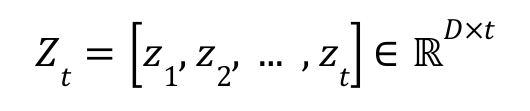
Post-activations produced at each internal tick are collected into a post-activation history matrix:
A synchronisation matrix is then defined:
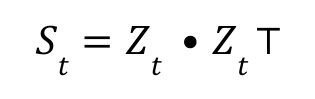
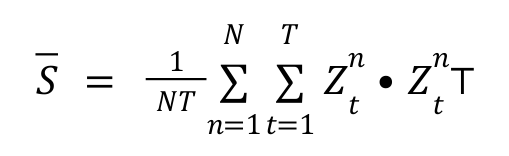
This matrix describes how strongly each pair of neurons co-activates over time. Because this matrix is dynamic and input-dependent, no single synchronisation matrix is treated as the model’s connectome. Instead, a stable CTM connectivity graph is defined as the population-averaged synchronisation matrix across many inputs, 𝑁, and internal ticks, 𝑇:
Harmonic Decomposition
To perform the eigendecomposition on the population-averaged synchronisation matrix . The 𝑆 graph Laplacian is formed, where is the degree matrix, and the eigenvalue 𝐿 = 𝐷 −𝑆 𝐷 problem is solved. 𝐿𝑢ₖ = λₖ𝑢ₖ
The resulting eigenvectors , ordered by increasing , are the CTM’s eigenmodes, which I 𝑢ₖ λₖ refer to as harmonic modes. Having obtained the CTM’s harmonic modes and the neuron activation time series, the next step is to project the CTM’s activity onto its harmonic modes at each internal tick.
At internal time step the CTM has an activation vector , where each component of this 𝑡 𝑎(𝑡) vector is the activation of one neuron at that tick. The CTM has neurons, has elements. 𝐷 𝑎(𝑡) 𝐷
Let the Laplacian eigenvectors of the CTM connectivity graph be denoted by , 𝑢1, 𝑢2, ... , 𝑢𝐷
To express the CTM’s activity in harmonic basis, a coefficient is computed for each mode αₖ(𝑡) ,as the dot product between the activation vector and the k-th eigenvector: 𝑘
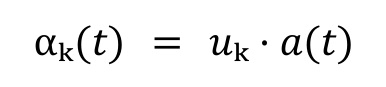
This number measures how strongly the k-th harmonic pattern is present in the CTM’s overall activity at time . A large positive value means the current neural activity closely matches that 𝑡 harmonic pattern, a value of zero means the pattern is absent and a negative value means the activity resembles the opposite of that pattern.
Repeating this projection for every internal tick produces a time series 𝑡 = 1, ... , 𝑇 for each harmonic mode. These are the mode activation time courses. αₖ(1), αₖ(2), …, αₖ(𝑇) 𝑘
Under this representation, the CTM’s internal state at time can be described as a point in 𝑡 harmonic space whose coordinates are:

As the CTM runs over internal ticks, this point moves through harmonic space, tracing a trajectory that represents the model’s evolving internal state.
Having obtained the CTM’s harmonic representation for each mode at each internal tick αₖ(𝑡) 𝑘 , the model’s internal dynamics can be analysed with the same class of quantitative metrics 𝑡 commonly applied in brain CHD. These metrics allow us to characterise how the CTM distributes activity across harmonic modes over time.
Mode power
The contribution of each harmonic mode over the course of a computation is quantified via its average power:
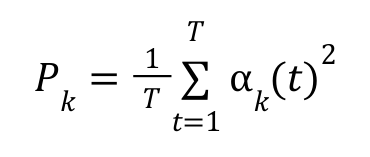
This measures the typical contribution of mode to the CTM’s activity across the entire 𝑘 computation. Modes with large dominate the model’s behaviour, whereas modes with small 𝑃ₖ are rarely engaged. By ranking modes according to , the harmonic patterns that are most 𝑃ₖ 𝑃ₖ functionally relevant for a computation task can be identified.
Mode entropy over time
To assess how concentrated or distributed the CTM’s activity is at each moment, a normalised power distribution over modes is computed:
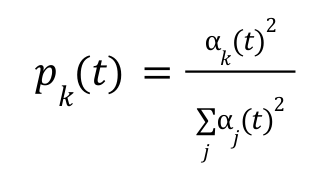
This expresses the fraction of total activity carried by each mode at time . The entropy of this distribution is defined as:
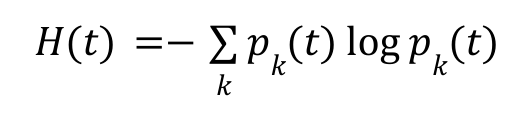
High entropy indicates that activity is spread relatively evenly across many modes, whereas low entropy indicates that only a few modes dominate. Plotting across internal ticks yields an 𝐻(𝑡) entropy trajectory that reveals if the CTM begins in a diffuse, exploratory regime and gradually transitions to a more focused state as it converges on a solution.
Distribution of mode powers
Beyond time resolved measures, the overall distribution of mode powers is analysed across all 𝑃ₖ harmonics. Specifically, a histogram of values is constructed and visualised on log-log axes. 𝑃ₖ This allows assessment of if the CTM’s activity is dominated by a small number of modes or distributed more broadly across the spectrum.
A distribution concentrated on a few high power modes indicates a more ordered or low dimensional regime, whereas a broad, heavy-tailed distribution suggests that many modes contribute meaningfully to the CTM’s dynamics.
Metastable states via clustering
Finally, metastable structure in the CTM’s dynamics is examined. At each internal tick , the 𝑡 model’s state is represented as a point in harmonic space:

Clustering methods are then applied to these vectors across time. If distinct clusters emerge and the CTM spends contiguous stretches of time within them, this suggests the presence of metastable states, preferred regions of harmonic space that structure the model’s computation.
In summary, Chapter 2 develops a graph-spectral pipeline that derives a CTM-specific harmonic basis from a population-averaged synchronisation graph and analyses the model’s internal trajectories in this harmonic space.
Chapter 3: Evaluation of Interpretability Claims
This chapter outlines how I will empirically test and demonstrate the CHD-based interpretability framework on CTMs. It describes the tasks used to evaluate the proposed interpretability method, what data I will collect and analyse from these tests and the results I will look for in each case.
Task Conditions for Analysis
I plan to evaluate CTM dynamics on two benchmark tasks from Darlow et al.: 2D maze solving and image classification, to see how the CHD-based interpretation might vary with the nature of the task.
2D Maze Solving: The CTM will be evaluated on grid-based maze tasks that require sequential planning. Maze solving unfolds through extended behavioural phases such as exploration, backtracking, and solution commitment that require internally consistent control policies over many time steps. In the CTM, the internally consistent control policies underlying these behavioural phases are expected to correspond to recurrent and low-variance configurations of interacting harmonic modes that persist until environmental constraints force a reorganisation, providing a basis for identifying metastable mode clusters. By varying maze size and structural complexity, I will test how increased task difficulty produces predictable changes in harmonic mode utilisation, such as broader spectral engagement or increased instability in mode combinations.
Image Classification: The CTM will be evaluated on the CIFAR-10 and CIFAR-100 image datasets (Krizhevsky, 2012) for the purpose of examining the relationship between harmonic mode activity and classification. Classification is treated as a temporally extended process during which the relative activation strengths of harmonic modes change across inference time as the network aggregates input features and stabilises around a single output class. I will analyse differences in mode trajectories associated with correct and incorrect classifications to isolate failure related mode configurations. Increasing label granularity from CIFAR-10 to CIFAR-100 increases the number of competing output classes, requiring finer feature differentiation and extended resolution across inference time. Changes in convergence time, mode transition frequency, and configuration stability will be analysed across CIFAR-10 and CIFAR-100 to characterise how increased label granularity alters harmonic dynamics.
Analysis of Internal Dynamics Across Tasks
For each task scenario, I will collect the full time series of neuron activations from the CTM. I will then apply the CHD-based analysis to this data as described in Chapter 2. The analysis for each task will go through the following steps:
1) Model training and activity collection
Each CTM architecture is first trained to converge on its respective task distribution. After training is complete, the model’s learned parameters are frozen. All subsequent analyses are performed on this fixed model.
The trained CTM is then run on a separate collection of previously unseen instances of the same task used for training. During these runs, neuron activation vectors are recorded at every α(𝑡) internal processing tick. These recordings are aggregated across inputs and time to estimate a model-level synchronisation structure.
2) Compute Harmonic Basis
From this fixed connectivity graph, I compute the graph Laplacian and solve the eigenvalue problem. The resulting eigenvectors define the CTM’s harmonic modes and the eigenvalues define their spectral ordering. This harmonic basis is computed once per trained model and is held fixed for all subsequent task-specific analyses. If the model architecture or parameters are altered in any way, the basis is recomputed.
3) Project task-evoked activity onto harmonic modes
With the harmonic basis fixed, the CTM is then run on the evaluation tasks and conditions. For each run, neuron activation vectors are recorded and projected onto the precomputed α(𝑡) harmonic modes. Because the basis is fixed across conditions, differences in trajectories can α(𝑡) be attributed to changes in internal dynamics induced by the task.
4) Analysis of task-evoked harmonic dynamics
The resulting trajectories are analysed to evaluate if and how tasks induce structured and interpretable organisation in harmonic space. Analysis focuses on:
● Mode engagement patterns shown by the mode power over time.
● Entropy trajectories reflecting concentration or dispersion of activity.
● Metastable states and transition structure identified through clustering in harmonic space.
These analyses test if the CTM’s internal computation proceeds through repeatable dynamical regimes and how those regimes may shift systematically with task demands.
Chapter 4: Hypothesised Outcomes and Potential Insights
If the proposed framework works as intended, I predict that CHD will reveal meaningful structure in the CTM’s internal dynamics, providing human-interpretable descriptions of its behaviour. For example, harmonic analysis may indicate that the CTM spent the first half of its processing in a high entropy regime with distributed mode power, followed by a low entropy regime with mode power concentrated to a smaller subset of harmonic modes relevant to decision-making. Such an outcome would provide evidence in favour of CHD as an interpretability tool because it transforms an intractably large set of neuron activations into a conceptual narrative about the model’s strategy. More concretely, I expect CHD to identify distinct dynamical regimes during task execution. In structured tasks such as maze solving, these regimes may correspond to phases such as exploration, backtracking, and final commitment to a solution. However, temporal alignment with distinguishable task events alone is insufficient to establish what the system is representing or computing, as many internal signals may correlate with external task structure without playing a functional role. Accordingly, interpretability is supported only if these harmonic regimes exhibit predictive or constraining relationships with subsequent internal transitions or actions. Regime identity should reliably anticipate future behavioural choices, changes in entropy, or error likelihood across runs and task variations. If harmonic regimes both recur consistently and carry predictive information about the system’s future behaviour under blinded evaluation, this would provide evidence that CHD identifies salient internal dynamics that participate in the organisation of computation rather than merely reflecting task timing, supporting its use as an interpretability method.
Implications for Machine Learning
If CHD proves to be a useful interpretability tool for CTMs, it may inform the analysis and development of Continuous Thought Machines and related synchronisation-based recurrent architectures. In particular, if specific harmonic modes are found to be consistently associated with identifiable computational roles, these modes could be monitored in trained or partially trained models to characterise changes in internal organisation over learning. Because harmonic analysis requires access to stable internal dynamics, such analyses would apply to frozen models or to training regimes that alternate between optimisation and analysis phases rather than being applied continuously during gradient updates. Within these constraints, a harmonic representation offers a consistent coordinate system to examine how internal state trajectories are distributed across scales and how this organisation evolves with training. More broadly, this perspective contributes to interpretable AI by framing explanations in terms of internal dynamical structure and state transitions, which may be relevant for temporally extended or sequential decision-making processes.
Limitations and Caveats
Analogical Limits: The CTM connectome-equivalent that is used to derive harmonics is not a fixed connection diagram but a statistical aggregate of activity. Because this graph is derived from the model’s own activity, its structure is partly shaped by the tasks and data on which the CTM was optimised, introducing a degree of circularity between the basis and the dynamics being analysed. For this reason, the resulting harmonics should be interpreted as describing functional organisation rather than as a task-independent structure of the network. This limits the explanative capabilities of this interpretability technique to explaining howactivity is organised in such a way, as opposed to explaining whyactivity is organised in such a way.
Sampling: The CTM uses neuron synchronisation pairs to construct a latent representation from which it produces outputs. The number of unique pairs of neurons grows quadratically with the number of neurons. To reduce the required computational cost, only some chosen neurons form the next latent representation. Darlow et al. give three approaches to selecting neuron pairs: dense, semi-dense and random and they select the pairing approach based on suitability for the task.
From an interpretability perspective, selecting neuron pairs is methodologically significant. Using smaller subsets of neuron pairs for the output and action synchronisation representations affect the network’s dynamics by concentrating task-relevant and action-relevant structure within the corresponding neuron subspaces. On one hand, this concentration can simplify analysis by isolating the components of the network most directly involved in task execution or decision making. On the other hand, it may obscure broader interactions across the full network, limiting the extent to which conclusions drawn from these subspaces generalise to the CTM’s overall dynamics.
Consequently, an effective interpretability approach should examine both sampled and non-sampled neuron pair configurations to characterise how selection strategies influence the observed dynamics. Comparing analyses performed on the full synchronisation set and on selected subspaces provides a way to assess the effect of sampling on the resulting dynamical signatures. Therefore where sampling is required due to the computational cost of computing the entire synchronisation matrix, evaluating the chosen sampling configurations against an unsampled configuration is necessary.
Interpretation Subjectivity: Interpreting the functional significance of individual harmonic modes involves a qualitative component. While the harmonic decomposition yields a well defined representation of the activity of the network, assigning semantic meaning to specific modes is not fully determined by the analysis itself. Different researchers may emphasise different aspects of a mode’s activation pattern when proposing functional interpretations.
To limit interpretive bias, predictive or blinded evaluations in which mode activity is used to infer task phase or outcome without prior semantic assignment should be used where possible. These tests assess if the extracted dynamical structure carries explanatory or predictive value beyond descriptive correlation, helping to delineate the scope and limits of functional interpretation.
Annotated Bibliography
Atasoy et al. (2016) - “Human brain networks function in connectome-specific harmonic waves.” - This paper introduced the concept of connectome harmonics for understanding networks in the brain. It demonstrated that eigenmodes of the human brain’s structural network can serve as a basis for describing a wide range of brain activity patterns. Notably, the authors found that certain low frequency harmonics correspond to known resting-state networks, linking structural eigenmodes to functional brain organisation. I will use this reference as the foundational methodology for CHD. It provides the mathematical framework for computing connectome harmonics and shows the feasibility of representing complex dynamics in a low dimensional basis. Relevant to this proposal, this paper supports the idea that projecting high dimensional neural data onto eigenmodes can yield interpretable structure.
Atasoy et al. (2017) - “Connectome-harmonic decomposition of human brain activity reveals dynamical repertoire re-organisation under LSD.” - This study applied CHD to brain fMRI data under the influence of the psychedelic drug LSD. It found that LSD induces marked changes in brain dynamics, specifically, it increased the power of high frequency harmonic brain states and increased the distribution of harmonic activation. I cite this work for two reasons, firstly it introduces harmonic power and the distribution of harmonic activation, referred to as repertoire diversity by Atasoy, as metrics for CHD analysis. Secondly, it reinforces the idea that these metrics are linked to altered cognitive states. This reference will help justify why the mode power and distribution are measured in the CTM and provides a template for interpreting such findings.
Carhart-Harris et al. (2014) - “The entropic brain: a theory of conscious states informed by neuroimaging research with psychedelic drugs.” - This paper proposes that the entropy of brain activity is a key index of conscious states. In summary, normal waking consciousness is hypothesised to be slightly lower in entropy whereas states like the psychedelic state are higher entropy. I will use this source to inform my framing of entropy trajectories in cognitive processing. The entropic brain theory underpins the idea that tracking the entropy of the CTM’s activation patterns over time can indicate if it’s in an exploratory (high entropy) or focused (low entropy) phase. Carhart-Harris et al.’s perspective supports the aim to interpret rising or falling entropy in terms of flexible and constrained processing.
Ceni et al. (2019) - “Interpreting recurrent neural networks’ behaviour via excitable network attractors.” - This paper presents a dynamical-systems-based approach to interpreting RNNs, specifically a type of RNN called an echo-state network. Ceni and colleagues analyse RNN hidden states as trajectories in a continuous phase space and identify excitable attractors and transition pathways that correspond to distinct computational regimes. Their results show that interpretable structures can be extracted from recurrent dynamics and related to how networks implement task-relevant computations.
This reference supports the claim that RNN behaviour can be interpreted through internal state-space analysis rather than solely through input-output mappings. The authors validate their analysis on a flip-flop task, a benchmark task designed to elicit stable internal states and controlled switching dynamics. They note that for more complex dynamical tasks the explicit computation of bifurcation structure may become impractical. The analysis in this proposal is concerned with models and tasks that exhibit higher-dimensional dynamics than those described by low dimensional attractor structure alone. In this context, the paper establishes both the feasibility and the practical scope of attractor-based interpretations, providing a useful point of comparison for alternative dynamical analysis methods. Accordingly, direct comparison is limited by task complexity and the differences in model architecture between CTMs and the echo-state network they use.
Darlow et al. (2025) - “Continuous Thought Machines.” - This paper introduces the CTM, a neural architecture that performs computation via the evolution of neuron-level activation histories over time, as opposed to single-step activation values. The CTM differs from conventional feedforward and recurrent models in that computation unfolds over an internal sequence of discrete “thought steps.” At each step, neuron activations evolve according to privately parameterised temporal models rather than static activation functions. Interactions between neurons are described via pairwise synchronisation computed from histories of post-activations, the resulting synchronisation matrix is used as the latent representation for attention and output generation.
The CTM exhibits internal dynamics that are both directly observable and causally involved in task performance. This allows task-relevant internal activity to be examined as structured relationships expressed through time varying dynamics. In particular, the separation between neuron activation histories, a derived population-level synchronisation matrix and task-level outputs provide the components needed to construct a distinction between connectivity and time varying activity. This is because connectivity can be defined as a structure independently of momentary activity, while function can be expressed as trajectories through that structure.
In context, this work sits at the intersection of recent efforts to reintroduce recurrence and internal deliberation into neural networks. However, unlike approaches that treat recurrence as a means of processing sequential data, the CTM treats internal time as a variable over which the internal state evolves, for both static and sequential inputs.
An important design choice is the CTM’s loss function as it applies supervision at the internal ticks corresponding to minimum loss and maximum certainty rather than optimising the final tick alone. This explicitly incentivises useful intermediate computations but also incorporates a particular notion of what constitutes a “good” thought step. As certainty is defined in terms of prediction entropy, the method assumes that increasing certainty reflects meaningful task progress and this may not be true for tasks that are not naturally framed as classification. Interpretation of internal dynamics must therefore be understood relative to the training objective that shaped them, that is, a minimisation of loss and maximisation of certainty across internal ticks.
Schmidgall et al. (2024) - “Brain-inspired learning in artificial neural networks: a review.” - This review surveys recent attempts to move beyond static, feedforward artificial neural networks by incorporating biologically inspired learning mechanisms including neuromodulation, local learning rules and explicitly time dependent dynamics. A key argument of the paper is that many limitations of standard ANNs stem from their reliance on static architectures and global error driven training. The authors explicitly argue that current research is shifting toward networks with computation that unfolds over time and learning mechanisms that more closely resemble those observed in biological systems. I cite this work to situate CTM within this shift toward dynamic, temporally extended models of computation. With this shift, analysing evolving internal activity is becoming increasingly relevant for model evaluation and development.
Shuman et al. (2013) - “The emerging field of signal processing on graphs: Extending high-dimensional data analysis to networks and other irregular domains.” - This review paper surveys the emerging field of graph signal processing, generalising classical signal processing concepts such as Fourier transforms, frequency, and filtering to data defined on graphs. The authors introduce the graph Laplacian as a central operator for defining spectral representations of signals on irregular structures and review how its eigenvectors can be interpreted as graph-frequency components. Low frequency components correspond to smooth variations over the graph while high frequency components describe more localised or rapidly varying structure.
The relevance of this review to the present proposal lies primarily in its conceptual framing rather than in any specific algorithmic contribution. Shuman et al. provide a clear and general justification for treating Laplacian eigenmodes as a meaningful basis for analysing activity distributed over a network, independent of whether the network is biological or artificial. This framing supports the use of harmonic decompositions as a method to relate activity patterns to underlying connectivity structure, this is the central methodological move in adapting CHD to CTMs.
Importantly, the review emphasises that graph spectral methods provide a common language for analysing signals across diverse domains, including sensor networks, social networks, and biological systems. This supports the broader motivation that harmonic analysis is not inherently tied to neuroscience and is instead a general tool for interpreting structured activity on networks. That said, the review largely focuses on static signals or single-shot analyses, treating time primarily as an external scale or diffusion parameter, and does not address temporally extended computation or recurrent dynamics. By situating the proposed CHD-based analysis of CTMs within the broader graph signal processing literature, this reference helps clarify that the project is not introducing a novel mathematical technique, but rather applying an established interpretive framework to a new kind of neural network architecture. This strengthens the methodological legitimacy of the approach while highlighting the focus on dynamic interpretability rather than mathematical novelty.
Bibliography
Atasoy, S., Donnelly, I. and Pearson, J. (2016). Human brain networks function in connectome-specific harmonic waves. Nature Communications, 7(1). doi: https://doi.org/10.1038/ncomms10340.
Atasoy, S., Roseman, L., Kaelen, M., Kringelbach, M.L., Deco, G. and Carhart-Harris, R.L. (2017). Connectome-harmonic decomposition of human brain activity reveals dynamical repertoire re-organization under LSD. Scientific Reports, 7(1). doi: https://doi.org/10.1038/s41598-017-17546-0.
Carhart-Harris, R.L., Leech, R., Hellyer, P.J., Shanahan, M., Feilding, A., Tagliazucchi, E., Chialvo, D.R. and Nutt, D. (2014). The entropic brain: a theory of conscious states informed by neuroimaging research with psychedelic drugs. Frontiers in Human Neuroscience, 8(20). doi: https://doi.org/10.3389/fnhum.2014.00020.
Ceni, A., Ashwin, P. and Livi, L. (2019). Interpreting Recurrent Neural Networks Behaviour via Excitable Network Attractors. Cognitive Computation, 12(2), pp.330–356. doi: https://doi.org/10.1007/s12559-019-09634-2.
Darlow, L., Regan, C., Risi, S., Seely, J. and Jones, L. (2025). Continuous Thought Machines. [online] arXiv.org. Available at: https://arxiv.org/abs/2505.05522.
Durstewitz, D. (2017). A state space approach for piecewise-linear recurrent neural networks for identifying computational dynamics from neural measurements. PLOS Computational Biology, 13(6), pp.e1005542–e1005542. doi: https://doi.org/10.1371/journal.pcbi.1005542.
Krizhevsky, A. (2012). Learning Multiple Layers of Features from Tiny Images. [online] ResearchGate. Available at: https://www.researchgate.net/publication/265748773_Learning_Multiple_Layers_of_Features_from_Tiny_Images.
Schmidgall, S., Rojin Ziaei, Achterberg, J., Kirsch, L., S. Pardis Hajiseyedrazi and Eshraghian, J. (2024). Brain-inspired learning in artificial neural networks: A review. APL machine learning, [online] 2(2). doi: https://doi.org/10.1063/5.0186054.
Sedler, A.R., Versteeg, C. and Pandarinath, C. (2023). Expressive architectures enhance interpretability of dynamics-based neural population models. Neurons, Behavior, Data analysis, and Theory. doi: https://doi.org/10.51628/001c.73987.
Shuman, D.I., Narang, S.K., Frossard, P., Ortega, A. and Vandergheynst, P. (2013). The emerging field of signal processing on graphs: Extending high-dimensional data analysis to networks and other irregular domains. IEEE Signal Processing Magazine, [online] 30(3), pp.83–98. doi: https://doi.org/10.1109/msp.2012.2235192.
Viol, A., Palhano-Fontes, F., Onias, H., de Araujo, D.B. and Viswanathan, G.M. (2017). Shannon entropy of brain functional complex networks under the influence of the psychedelic Ayahuasca. Scientific Reports, 7(1). doi: https://doi.org/10.1038/s41598-017-06854-0.
Zhang, Y., Tino, P., Leonardis, A. and Tang, K. (2021). A Survey on Neural Network Interpretability. IEEE Transactions on Emerging Topics in Computational Intelligence, 5(5), pp.726–742. doi: https://doi.org/10.1109/tetci.2021.3100641.
